



As the General Court moves through the heart of its legislative session, one thing is clear: 2026 is shaping up to be one of the most consequential years for New Hampshire’s motor vehicle industry in recent memory.
Lawmakers are considering a wide-ranging slate of proposals that would redefine how vehicles are sold, titled, inspected, insured, repaired and even equipped. From electric vehicle classification to subscription-based vehicle features, inspection standards, workers’ compensation rules and insurance mandates, the scope of potential change is both broad and far-reaching.
NHADA’s legislative priorities this year are guided by a clear mission: protect consumer safety, preserve fair competition and ensure that New Hampshire’s motor vehicle businesses can continue to operate efficiently, profitably and responsibly.
The following are several of the most impactful issues now under active consideration.
Preserving Fair Market Competition
One of the most significant bills of the session would permit motor vehicle manufacturers to operate their own dealerships in markets already served by franchised businesses (HB 1041). This proposal represents a direct challenge to New Hampshire’s long-standing franchise protections.
The franchise system exists to ensure fair competition, consumer choice and local accountability. Allowing manufacturers to open factory-owned stores in existing markets would undermine private investment, distort price competition and place locally owned motor vehicle businesses at a disadvantage compared to multinational corporations with unlimited capital.
NHADA views this as a defining issue that could permanently reshape New Hampshire’s automotive marketplace.
Technology, Transparency and Consumer Rights
As vehicles become increasingly software-driven, lawmakers are examining how new technologies affect ownership rights and consumer transparency.
A high-priority proposal would regulate subscription-based vehicle features (HB 1146), potentially redefining how manufacturers charge consumers for built-in features delivered through software. While transparency is essential, poorly structured regulation could complicate vehicle sales, confuse consumers and place motor vehicle businesses in the middle of manufacturer billing models they do not control.
Another key bill would create a new classification for electric vehicles (HB 1410). EV classification impacts registration, taxation, inspection standards and future regulatory policy. Getting this framework right will shape New Hampshire’s EV market for years to come.
Inspection, Equipment and Safety Standards
Several proposals would directly affect vehicle inspections, service facilities and repair operations statewide.
New steering and suspension specifications (HB 1362) could expand inspection requirements and repair liability. While safety improvements are welcome, changes must be carefully crafted to avoid creating subjective inspection criteria that increase consumer disputes and administrative burdens for motor vehicle businesses.
Other bills would modify annual inspection standards and reinstatement rules (HB 1560), change mobile phone enforcement penalties (SB 649) and alter title exemptions for pre-2000 vehicles (HB 1421). Each carries downstream effects on compliance procedures, customer education and administrative exposure.
Title, Registration and Towing Reforms
A number of high-priority bills focus on modernizing New Hampshire’s title and registration framework:
- Trailer title requirements (HB 1466)
- Motorcycle title registration updates (HB 1430)
- New proof-of-insurance requirements at registration (HB 1558)
- Revised towing and appeal rules on public highways (HB 1492)
- Abandoned vehicle removal procedures (SB 617)
These proposals directly affect daily transaction workflows, lien processing, customer turnaround times and liability exposure across the motor vehicle industry.
Workforce Protection and Workers’ Compensation
Several high-priority bills would modify workers’ compensation medical billing rules and establish new workplace safety standards related to extreme temperature exposure (HB 1352, HB 1451).
Motor vehicle businesses support safe and healthy workplaces, but regulatory changes must balance worker protection with operational realities, particularly in service bays, collision facilities and outdoor work environments. NHADA’s advocacy efforts focus on protecting employee safety while preventing overly prescriptive rules that could drive up costs without improving outcomes.
Why Your Voice Matters
These proposals will shape:
- How vehicles are sold and serviced
- How inspections are performed
- How insurance and registration are processed
- How manufacturers compete in local markets
- How businesses manage compliance risk and labor costs
NHADA’s government relations team is actively engaged at the State House, but direct input from members remains the most influential tool in shaping legislative outcomes.
When you share how proposed changes affect your business, your employees and your customers, lawmakers listen.
Staying Engaged
This session will move quickly. Bills evolve rapidly through committee hearings, amendments and floor votes. NHADA will continue to provide timely updates, action alerts and advocacy opportunities to ensure that the motor vehicle industry’s voice is heard clearly and consistently.
Together, we can help shape thoughtful, balanced policy that protects consumers while keeping New Hampshire’s motor vehicle industry strong, competitive and locally rooted.
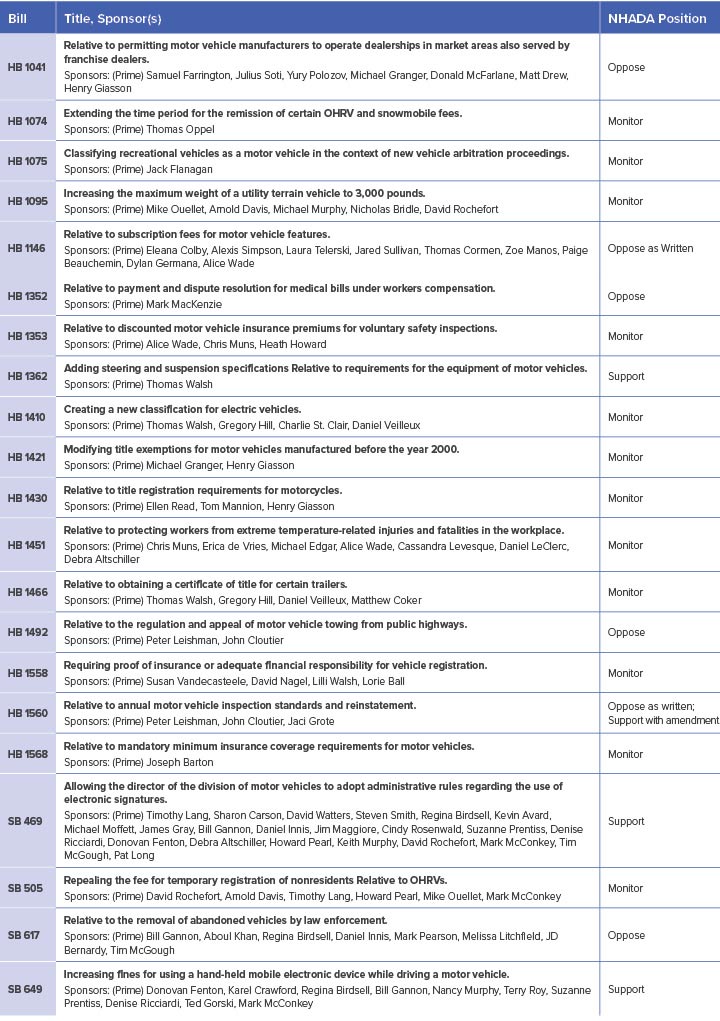
The following chart provides a more complete picture of NHADA’s current high-priority legislation. As always, don’t hesitate to reach out with any questions by contacting support@nhada.com or calling (603) 224-2369.
NHADA’s High-Priority Bills: 2026 Legislative Session